OCCT Fillets: Applying Variable Radius on Specific Corners of 2D Wires

While filleting all corners of a 2D wire with a uniform radius is common, OpenCascade Technology (OCCT) also provides the capability to apply fillets with different radii to specific, individual corners (vertices) of a wire. This allows for more nuanced and precise control over the shape of 2D profiles.
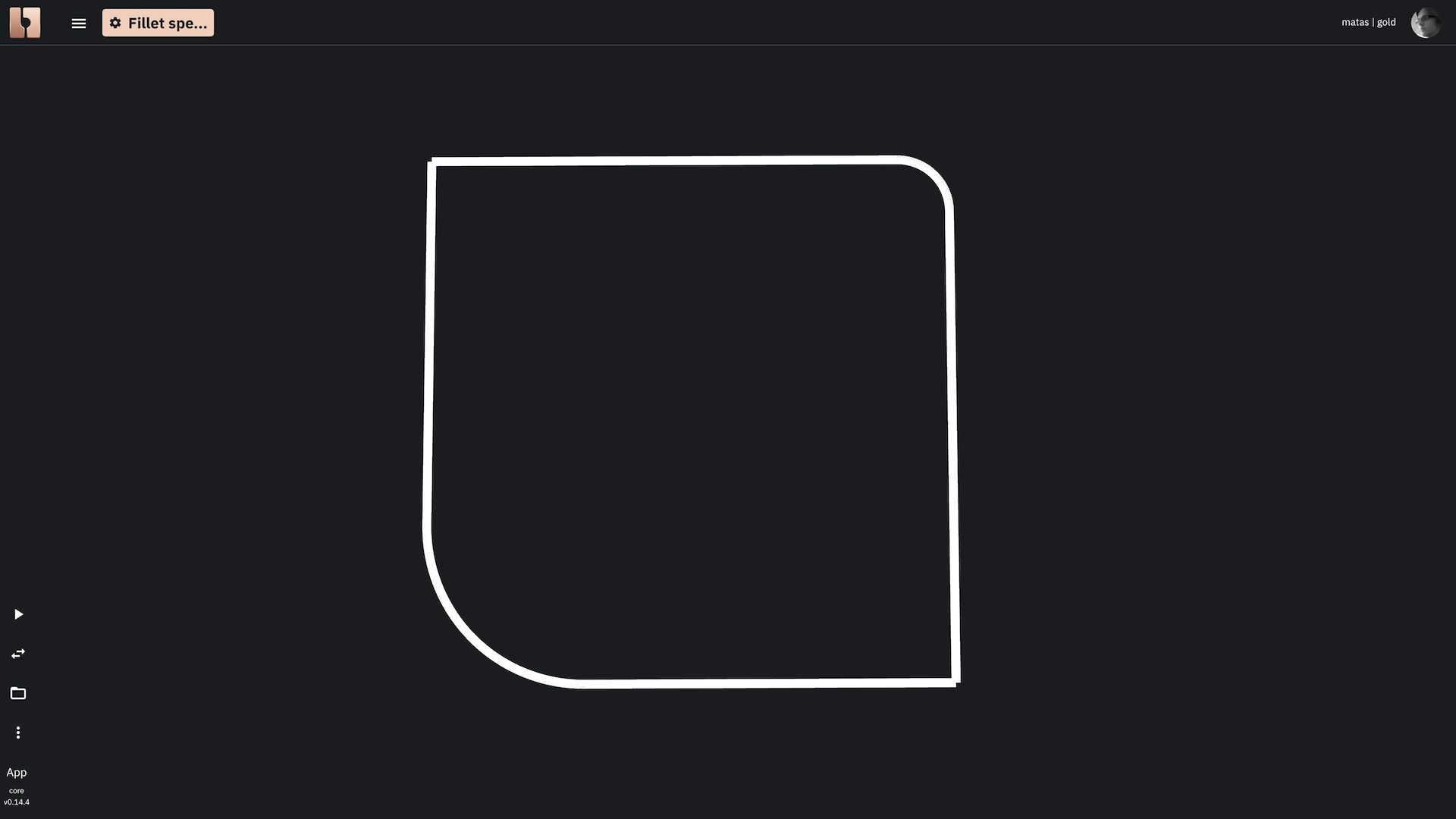 Fillets with variable radii on a 2D wire.
To achieve this, you typically need to:
- Identify Target Corners: Determine which vertices (corners) of the wire you want to fillet. This might involve knowing the order of vertices in the wire or selecting them based on their position.
- Provide Vertex and Radius Pairs: The fillet operation will usually require a list of target vertices (or their indexes within the wire) and the corresponding fillet radius to be applied at each of those specific corners.
The examples below demonstrate creating a 2D wire and then applying fillets with different radii to selected corners.
TypeScript Example: Fillet Specific Corners of a Wire with Variable Radii


const start = async () => {
    const squareOpt = new Bit.Inputs.OCCT.SquareDto();
    const square = await bitbybit.occt.shapes.wire.createSquareWire(squareOpt);
    const squareFillet = await bitbybit.occt.fillets.fillet2d({
        shape: square,
        radiusList: [0.1, 0.3],
        indexes: [1, 3]
    });

    bitbybit.draw.drawAnyAsync({
        entity: squareFillet
    });
}

start();
Blockly Example: Fillet Specific Corners of a Wire with Variable Radii

<xml xmlns="https://developers.google.com/blockly/xml"><block type="bitbybit.draw.drawAnyAsyncNoReturn" id="UO^K1-FNciNjT{DsaF2S" x="-386" y="-1094"><value name="Entity"><block type="bitbybit.occt.fillets.fillet2d" id="Ox7,%Hh~Fw+kv!s(Q7(E"><value name="Shape"><block type="bitbybit.occt.shapes.wire.createSquareWire" id=",($Iew6lo`C7aI%n5CC+"><value name="Size"><block type="math_number" id="q9G;9WNvj*j:)Zh|8?I}"><field name="NUM">1</field></block></value><value name="Center"><block type="bitbybit.point.pointXYZ" id="Q/^[^mqVSld+!6MnJF7("><value name="X"><block type="math_number" id="6p5j#W09R[]Yxt];FqX]"><field name="NUM">0</field></block></value><value name="Y"><block type="math_number" id="PE{_^g]~xSa?$OYiLWEw"><field name="NUM">0</field></block></value><value name="Z"><block type="math_number" id="ts@X1}R0SiC@`04![b2,"><field name="NUM">0</field></block></value></block></value><value name="Direction"><block type="bitbybit.vector.vectorXYZ" id="MSTpJ`{T;q4p[9yMb6$R"><value name="X"><block type="math_number" id="x_(L9{On`m!mzn)O!y5:"><field name="NUM">0</field></block></value><value name="Y"><block type="math_number" id="qLfDzEy[xPrrGi7dTB~a"><field name="NUM">1</field></block></value><value name="Z"><block type="math_number" id="lgc(z|+OX:qW]j1mIa:s"><field name="NUM">0</field></block></value></block></value></block></value><value name="RadiusList"><block type="lists_create_with" id="/Hd5KW,VCB6,2Q$eygd{"><mutation items="2"></mutation><value name="ADD0"><block type="math_number" id="C0dr`B1U7Dv)=uGdnkW$"><field name="NUM">0.1</field></block></value><value name="ADD1"><block type="math_number" id="?~Vc_oJGQ,,TPmBkZ^5S"><field name="NUM">0.3</field></block></value></block></value><value name="Indexes"><block type="lists_create_with" id="%0Q$(=odS^{~-+Eqh}-J"><mutation items="2"></mutation><value name="ADD0"><block type="math_number" id="RCb7G`7@dxSwZHEc:zMb"><field name="NUM">1</field></block></value><value name="ADD1"><block type="math_number" id="Vk$pJ#[mvN%^BiI0Q1Pl"><field name="NUM">3</field></block></value></block></value></block></value></block></xml>
Rete Example: Fillet Specific Corners of a Wire with Variable Radii

{
  "id": "rete-v2-json",
  "nodes": {
    "fc07e0c542a94302": {
      "id": "fc07e0c542a94302",
      "name": "bitbybit.occt.shapes.wire.createSquareWire",
      "customName": "square wire",
      "async": true,
      "drawable": true,
      "data": {
        "genericNodeData": {
          "hide": true,
          "oneOnOne": false,
          "flatten": 0,
          "forceExecution": false
        },
        "size": 1,
        "center": [
          0,
          0,
          0
        ],
        "direction": [
          0,
          1,
          0
        ]
      },
      "inputs": {},
      "position": [
        874.4804222774951,
        611.1219530666237
      ]
    },
    "80bd1bbd7593daa6": {
      "id": "80bd1bbd7593daa6",
      "name": "bitbybit.json.parse",
      "customName": "parse",
      "async": false,
      "drawable": false,
      "data": {
        "genericNodeData": {
          "hide": false,
          "oneOnOne": false,
          "flatten": 0,
          "forceExecution": false
        },
        "text": "[1, 3]"
      },
      "inputs": {},
      "position": [
        881.1825628672659,
        1297.4887643425693
      ]
    },
    "ee9394c0ea645cc9": {
      "id": "ee9394c0ea645cc9",
      "name": "bitbybit.occt.fillets.fillet2d",
      "customName": "fillet 2d",
      "async": true,
      "drawable": true,
      "data": {
        "genericNodeData": {
          "hide": false,
          "oneOnOne": false,
          "flatten": 0,
          "forceExecution": false
        },
        "radius": 0.1
      },
      "inputs": {
        "indexes": {
          "connections": [
            {
              "node": "80bd1bbd7593daa6",
              "output": "result",
              "data": {}
            }
          ]
        },
        "shape": {
          "connections": [
            {
              "node": "fc07e0c542a94302",
              "output": "result",
              "data": {}
            }
          ]
        },
        "radiusList": {
          "connections": [
            {
              "node": "f129862d3eb80edb",
              "output": "result",
              "data": {}
            }
          ]
        }
      },
      "position": [
        1417.0916481447425,
        919.1470674425932
      ]
    },
    "f129862d3eb80edb": {
      "id": "f129862d3eb80edb",
      "name": "bitbybit.json.parse",
      "customName": "parse",
      "async": false,
      "drawable": false,
      "data": {
        "genericNodeData": {
          "hide": false,
          "oneOnOne": false,
          "flatten": 0,
          "forceExecution": false
        },
        "text": "[0.2, 0.3]"
      },
      "inputs": {},
      "position": [
        881.0722766958328,
        1002.8610291015843
      ]
    }
  }
}
Applying variable radius fillets to specific corners of 2D wires is a powerful technique for creating custom profiles with precise rounded features, which can then be used as a basis for more complex 3D modeling operations.