Picking faces and edges
A fillet rounds edges, a shell removes faces, a draft tilts them. Each needs to know which ones. OpenCascade numbers the faces and edges of every shape, and many functions take a list of those numbers, indexes. There are three ways to come by them.
By index
Draw the shape with its indexes shown (drawEdgeIndexes or drawFaceIndexes in the drawing options), read the numbers off the screen and type them in. Edge indexes shows how.
It is quick, and it is fragile: the numbers belong to this shape as it is now. Change a size, add a hole, and the edge you meant may get another number while your list now points at a different one.
By rule
bitbybit.occt.select chooses faces and edges by what they are and where they lie: faces facing a direction, edges along an axis, circular edges of a radius, edges inside a box or on a plane, the edges where two sets of faces meet. Each function returns the indexes for you, so a rule keeps choosing the right ones however the model changes.
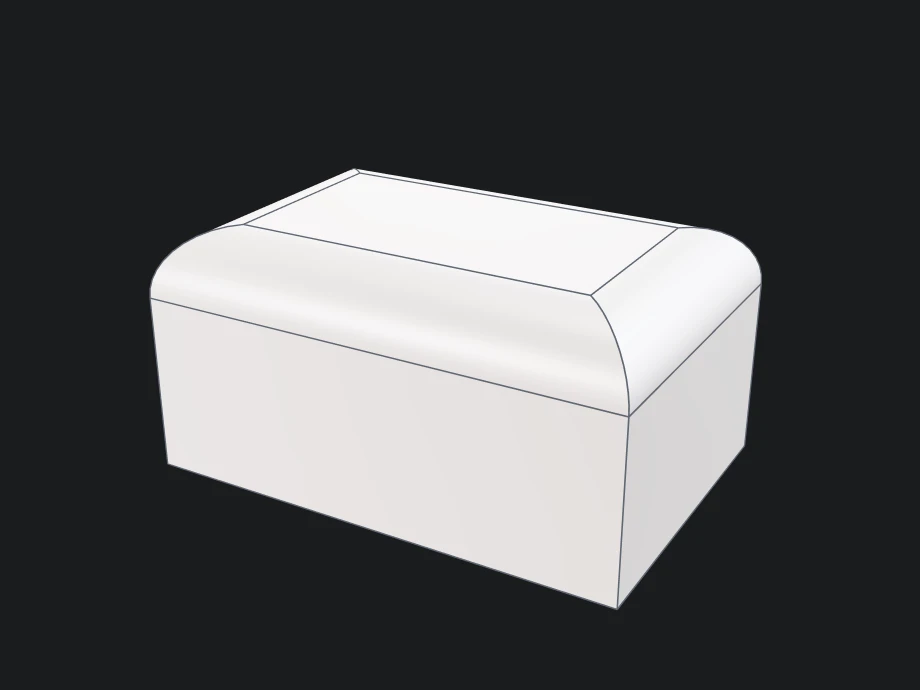
Here the faces that face up are chosen first, then the edges around them, and only those edges are filleted. Change the box's sizes and the top edges are still the ones rounded:
- Rete
- Blockly
- TypeScript


{
  "id": "rete-v2-json",
  "nodes": {
    "box": {
      "id": "box",
      "name": "bitbybit.occt.shapes.solid.createBox",
      "customName": "box",
      "async": true,
      "drawable": true,
      "data": {
        "genericNodeData": {
          "hide": true,
          "oneOnOne": false,
          "flatten": 0,
          "forceExecution": false
        },
        "width": 6,
        "length": 4,
        "height": 3,
        "center": [
          0,
          0,
          0
        ],
        "originOnCenter": true
      },
      "inputs": {},
      "position": [
        40,
        40
      ]
    },
    "up": {
      "id": "up",
      "name": "bitbybit.occt.select.faces.facing",
      "customName": "faces facing",
      "async": true,
      "drawable": false,
      "data": {
        "genericNodeData": {
          "hide": false,
          "oneOnOne": false,
          "flatten": 0,
          "forceExecution": false
        },
        "direction": [
          0,
          1,
          0
        ],
        "angle": 0
      },
      "inputs": {
        "shape": {
          "connections": [
            {
              "node": "box",
              "output": "result",
              "data": {}
            }
          ]
        }
      },
      "position": [
        460,
        40
      ]
    },
    "around": {
      "id": "around",
      "name": "bitbybit.occt.select.edges.ofFaces",
      "customName": "edges of faces",
      "async": true,
      "drawable": false,
      "data": {
        "genericNodeData": {
          "hide": false,
          "oneOnOne": false,
          "flatten": 0,
          "forceExecution": false
        }
      },
      "inputs": {
        "shape": {
          "connections": [
            {
              "node": "box",
              "output": "result",
              "data": {}
            }
          ]
        },
        "indexes": {
          "connections": [
            {
              "node": "up",
              "output": "result",
              "data": {}
            }
          ]
        }
      },
      "position": [
        880,
        40
      ]
    },
    "fillet": {
      "id": "fillet",
      "name": "bitbybit.occt.fillets.filletEdges",
      "customName": "fillet edges",
      "async": true,
      "drawable": true,
      "data": {
        "genericNodeData": {
          "hide": false,
          "oneOnOne": false,
          "flatten": 0,
          "forceExecution": false
        },
        "radius": 0.8
      },
      "inputs": {
        "shape": {
          "connections": [
            {
              "node": "box",
              "output": "result",
              "data": {}
            }
          ]
        },
        "indexes": {
          "connections": [
            {
              "node": "around",
              "output": "result",
              "data": {}
            }
          ]
        }
      },
      "position": [
        1300,
        40
      ]
    }
  },
  "modules": {}
}

<xml xmlns="https://developers.google.com/blockly/xml"><variables><variable id="box">box</variable></variables><block type="variables_set" x="40" y="40"><field name="VAR" id="box">box</field><value name="VALUE"><block type="bitbybit.occt.shapes.solid.createBox"><value name="Width"><block type="math_number"><field name="NUM">6</field></block></value><value name="Length"><block type="math_number"><field name="NUM">4</field></block></value><value name="Height"><block type="math_number"><field name="NUM">3</field></block></value><value name="Center"><block type="bitbybit.point.pointXYZ"><value name="X"><block type="math_number"><field name="NUM">0</field></block></value><value name="Y"><block type="math_number"><field name="NUM">0</field></block></value><value name="Z"><block type="math_number"><field name="NUM">0</field></block></value></block></value><value name="OriginOnCenter"><block type="logic_boolean"><field name="BOOL">TRUE</field></block></value></block></value><next><block type="bitbybit.draw.drawAnyAsyncNoReturn"><value name="Entity"><block type="bitbybit.occt.fillets.filletEdges"><value name="Shape"><block type="variables_get"><field name="VAR" id="box">box</field></block></value><value name="Radius"><block type="math_number"><field name="NUM">0.8</field></block></value><value name="Indexes"><block type="bitbybit.occt.select.edges.ofFaces"><value name="Shape"><block type="variables_get"><field name="VAR" id="box">box</field></block></value><value name="Indexes"><block type="bitbybit.occt.select.faces.facing"><value name="Shape"><block type="variables_get"><field name="VAR" id="box">box</field></block></value><value name="Direction"><block type="bitbybit.vector.vectorXYZ"><value name="X"><block type="math_number"><field name="NUM">0</field></block></value><value name="Y"><block type="math_number"><field name="NUM">1</field></block></value><value name="Z"><block type="math_number"><field name="NUM">0</field></block></value></block></value><value name="Angle"><block type="math_number"><field name="NUM">0</field></block></value></block></value></block></value></block></value></block></next></block></xml>

const box = await bitbybit.occt.shapes.solid.createBox({ width: 6, length: 4, height: 3, center: [0, 0, 0] });
const up = await bitbybit.occt.select.faces.facing({ shape: box, direction: [0, 1, 0] });
const around = await bitbybit.occt.select.edges.ofFaces({ shape: box, indexes: up });
const rounded = await bitbybit.occt.fillets.filletEdges({ shape: box, radius: 0.8, indexes: around });

await bitbybit.draw.drawAnyAsync({ entity: rounded });
Rules combine: pass the indexes one rule found to the next, as above, to narrow a choice step by step.
Mind an empty choice. A rule that matches nothing returns an empty list, and filletEdges given no indexes rounds every edge. If more is rounded than you meant, check what the rule found: a direction slightly off, such as [0, 1, 1] instead of [0, 1, 0], with an angle of 0 finds no face at all.
By history
Some operations can report what became of each face, edge and vertex: the *WithHistory twins of the booleans, the features and drafts, the fillets and chamfers, the offsets, the sweeps and the splits, such as bitbybit.occt.booleans.differenceWithHistory, return beside the new shape which of its faces came from which of the old ones, so a drill's side is known to be the wall of its hole. A step built on such a face keeps finding it even after the steps before it change.
A twin takes what the plain function takes and returns { shape, history }. A history is lists of indexes, numbered as shapes.face.getFaces, shapes.edge.getEdges and shapes.vertex.getVertices number the faces, edges and vertices of the shape given and of the result alike:
faces[i]is what faceibecame: itself where it is unchanged, its pieces where it was cut, nothing where it is gone.edges[i]does the same for edgei.facesFromEdges[i]holds the faces made from edgei, such as the round a fillet puts along it or the side a sweep makes of it;facesFromVerticesandedgesFromVerticeshold what was made from a vertex, such as the blend where three rounds meet at a corner.facesFromFaces[i]holds the faces made from facei, such as the inner wall a thick solid offsets from it, andedgesFromFaces[i]the edges made on it, such as where a boolean cut it.firstFacesandlastFacesare where a sweep, a loft or a feature starts and ends, such as the two flat sides of a rib.
An operation that takes more than one shape returns { shape, histories }, one history for each shape it was given, in the order given: a groove reports the base's history, then the history of the wire that outlined it.
Here every edge of a box is rounded, and the history finds the faces the fillet made. The rounded box has 26 faces: the six of the box, trimmed, a round along each of its twelve edges and a blend at each of its eight corners.
const box = await bitbybit.occt.shapes.solid.createBox({ width: 4, length: 4, height: 2, center: [0, 1, 0] });
const edges = await bitbybit.occt.shapes.edge.getEdges({ shape: box });
const rounded = await bitbybit.occt.fillets.filletEdgesListOneRadiusWithHistory({ shape: box, edges, radius: 0.3 });
const faces = await bitbybit.occt.shapes.face.getFaces({ shape: rounded.shape });
const rounds = rounded.history.facesFromEdges.flat().map((index) => faces[index]);
const corners = rounded.history.facesFromVertices.flat().map((index) => faces[index]);
Each page says which of its functions keep a history: fillets, chamfers, features and drafts, offsets, pipes and sweeps, rotated extrusions and sections and splits.
Corners by a point
bitbybit.occt.corners rounds or bevels a single corner chosen by a point near it, without any index at all.